The 96h strike widely followed in UAC
- Hubert Tomèga

- Dec 30, 2024
- 3 min read
Academic activities at the University of Abomey-Calavi (UAC) are almost paralyzed. Since Tuesday, 13 February, students from the various schools and faculties of this university, the first in Benin, have only taken classes on Mondays, one day a week. And for good reason, the hardening of strike movements by higher education teachers and student organizations.
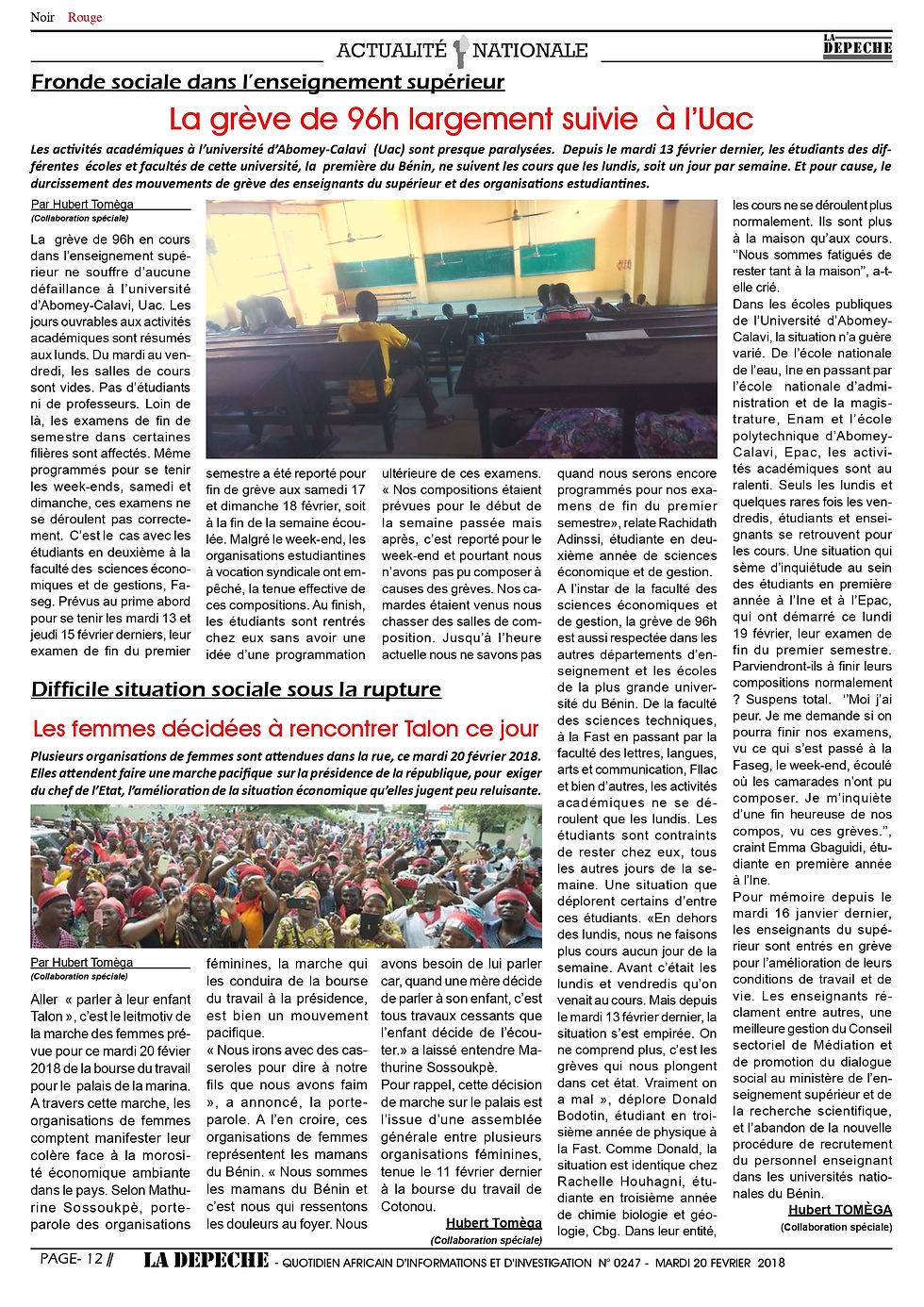
The 96h strike in higher education is not failing at the University of Abomey-Calavi, Uac. Academic days are summarized on Mondays. From Tuesday to Friday, the classrooms are empty. No students or faculty. Semester-end exams in some programs are affected. Even if they are scheduled to be held on weekends, Saturday and Sunday, these exams do not run properly. This is the case with the second year students in the faculty of economics and management, Faseg. Initially scheduled to be held on Tuesday 13 and Thursday 15 February, their examination at the end of the first half of the year was postponed for the end of the strike until Saturday 17 and Sunday 18 February, at the end of the past week. Despite the weekend, student organizations with a trade union vocation prevented the effective holding of these compositions. At the finish, students returned home without any idea of a future schedule for these exams. Our compositions were planned for the beginning of last week but after, it is postponed for the weekend and yet we could not compose because of the strikes. Our comrades had come to drive us out of the composition rooms. We don’t know yet when we will be scheduled for our first semester exams,' says Rachidath Adinssi, a second-year student in economics and management.
A widespread strike in all departments
Like the Faculty of Economics and Management, the 96h strike is also respected in other departments and schools of the largest university in Benin. From the faculty of technical sciences, to the Fast, through the faculty of letters, languages, arts and communication, Fllac and many others, academic activities take place only on Mondays. Students are forced to stay at home every other day of the week. Some of these students deplore this situation.
" Except on Mondays, we don’t teach any day of the week. Before that it was Monday and Friday when we would come to class. But since Tuesday, 13 February, the situation has worsened. We do not understand anymore, it is the strikes that plunge us into this state. Really we are in pain," says Donald Bodotin, a third-year physics student at Fast. Like Donald, the situation is similar for Rachelle Houhagni, a third-year student in chemistry, biology and geology at CBG. In their entity, classes are no longer run normally. They are more at home than in class. 'We are tired of staying so much at home', she cried.
National schools are not spared
In the public schools of the University of Abomey-Calavi, the situation has not changed much. From the National Water School, Ine to the Abomey-Calavi Polytechnic, and then to the National Administration and Judiciary School, Enam, academic activities are at a standstill. Only on Mondays and a few times on Fridays, students and teachers meet for classes. A situation that sows of concern among first-year students at l'Ine and EPAC, who started on Monday, February 19, their final exam in the first semester.Will they be able to finish their compositions normally? Total suspense. 'Moi I’m afraid. I wonder if we can finish our exams, given what happened at the Faseg, the weekend, after which the comrades could not compose. I am worried about a happy end of our compos, given these strikes.', fears Emma Gbaguidi, first year student at Ine.
For the record, since last Tuesday, January 16, teachers of higher education have gone on strike to improve their working and living conditions. The teachers are calling for better management of the Sectoral Council for Mediation and Promotion of Social Dialogue at the Ministry of Higher Education and Scientific Research, and the abandonment of the new procedure for recruiting teaching staff at Benin’s national universities.
Par Hubert Tomèga

Comments